
Does a Higher Extract Ratio Mean a Stronger Tongkat Ali Supplement?
LAST UPDATED:
21 September 2026

No. We bought 22 Tongkat Ali extracts on the open market and tested them in our own laboratory, which is accredited by Malaysia's National Pharmaceutical Regulatory Agency to authenticate Tongkat Ali. A product sold as 200:1 contained 0.05% eurycomanone. A product sold as 10:1 contained 0.98%, roughly 16 times more. The ratio on a Tongkat Ali label tells you about the manufacturing process, not about what ends up in the capsule.
2 of the 22 met the Malaysian Standard on all 4 measured compounds. Nothing on either label distinguished them from the 20 that did not.
What does 100:1 actually mean on a Tongkat Ali label?
It means the manufacturer started with 100 kilograms of raw root to produce 1 kilogram of extract. That is all it means. It describes an input, not an output.
The reasonable assumption is that a bigger first number means a more concentrated product, so a 100:1 must be 10 times stronger than a 10:1. It does not work that way. A high ratio can just as easily mean an inefficient extraction, where a lot of root was used badly and very little of the active compound made it through.
There is a second problem. Ratios are not comparable between suppliers. 2 manufacturers can both print 100:1 and mean completely different things by it, because there is no agreed definition of what the starting material is, how dry it was, or what counts as a finished extract. Within 1 supplier's range the number may track something real. Across 2 suppliers it is not a measurement at all.
We tested 22 Tongkat Ali extracts. Here is what we found.
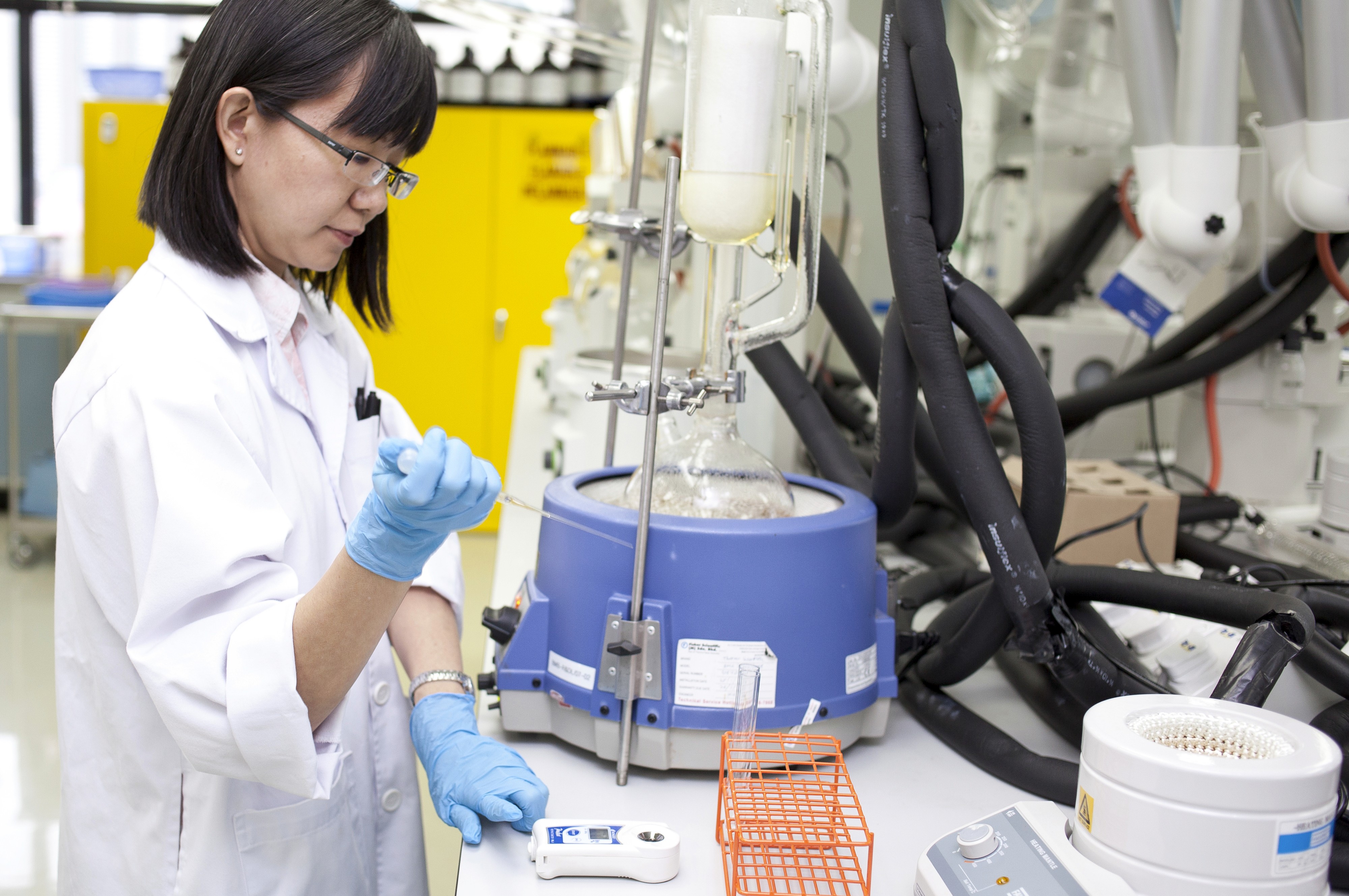
We purchased 22 Tongkat Ali extracts from suppliers in Malaysia, Indonesia, China and Japan, sold under a mix of extract ratios and eurycomanone percentages. Testing has run as a continuous programme since 2023. Supplier names are not disclosed.
Each sample was analyzed in our own chemistry laboratory, which holds accreditation from Malaysia's National Pharmaceutical Regulatory Agency, part of the Ministry of Health, for Tongkat Ali authentication testing. Every assay follows a validated method under MS2409:2011, the Malaysian Standard for standardized Tongkat Ali water extract:
Marker | Specification | Method used |
|---|---|---|
Eurycomanone | 0.8 to 1.5% | High performance liquid chromatography (HPLC) |
Total protein | 22% or higher | Lowry method |
Total polysaccharides | 30% or higher | Anthrone reagent |
Glycosaponin | 40% or higher | Gravimetric |
Sold as | Origin | Eurycomanone 0.8 to 1.5% | Protein 22%+ | Polysaccharide 30%+ | Glycosaponin 40%+ | Markers met |
|---|---|---|---|---|---|---|
100:1 powder extract | Malaysia | 1.23 | 26.70 | 31.30 | 52.50 | 4 of 4 |
1% eurycomanone | China | 1.02 | 23.10 | 33.89 | 62.70 | 4 of 4 |
1% eurycomanone | China | 1.09 | 63.98 | 10.65 | 71.00 | 3 of 4 |
100:1 water soluble | Japan | 1.40 | 30.00 | 23.24 | 53.60 | 3 of 4 |
Eurycomanone 2% or more | China | 1.86 | 23.50 | 41.24 | 63.13 | 3 of 4 |
10:1, eurycomanone 1% or more | China | 0.98 | 19.90 | 48.44 | 52.57 | 3 of 4 |
"One Hundred" | Indonesia | 0.53 | 25.37 | 46.66 | 30.60 | 2 of 4 |
3% eurycomanone | China | 2.16 | 51.61 | 3.00 | 73.00 | 2 of 4 |
10% eurycomanone | China | 11.67 | 50.81 | 3.15 | 88.30 | 2 of 4 |
2% eurycomanone | China | 1.67 | 42.60 | 5.85 | 67.10 | 2 of 4 |
5% eurycomanone | China | 3.16 | 70.06 | 9.60 | 74.00 | 2 of 4 |
8% eurycomanone | China | 6.97 | 32.31 | 21.59 | 70.90 | 2 of 4 |
Eurycomanone 1% or more | China | 0.61 | 19.30 | 50.54 | 53.19 | 2 of 4 |
200:1 (second source) | China | 0.25 | 6.20 | 58.50 | 44.70 | 2 of 4 |
10:1 | Indonesia | 0.15 | 0.80 | 81.20 | 7.50 | 1 of 4 |
20:1 | Indonesia | 0.20 | 0.60 | 83.00 | 19.40 | 1 of 4 |
50:1 | Indonesia | 0.51 | 6.92 | 69.20 | 28.30 | 1 of 4 |
100 fold concentrated | Japan | 0.80 | 21.55 | not tested | not tested | 1 of 2 tested |
200:1 | China | 0.05 | 0.10 | 80.80 | 3.70 | 1 of 4 |
100:1 | China | 0.06 | 0.10 | 81.00 | 3.80 | 1 of 4 |
0.1 to 0.3% eurycomanone | Malaysia | 0.07 | 5.44 | 23.09 | 21.70 | 0 of 4 |
2 to 3% eurycomanone | Malaysia | 0.68 | 17.12 | 29.25 | 37.90 | 0 of 4 |
All values are percentages by weight. 21 of the 22 samples were assessed against all 4 markers. 1 supplier's sample could not be tested for polysaccharide or glycosaponin, and it had already failed on protein.
10 of the 22 contained less eurycomanone than the standard's minimum. 6 contained more than its maximum. 9 fell short on polysaccharides. 2 met all 4.
The 2 ways a Tongkat Ali extract fails
The results fall into 2 clear patterns, and they fail in opposite directions.
Underextraction, which is what most ratio-labelled products showed. 4 samples sold as 10:1, 20:1, 100:1 and 200:1 measured between 0.05% and 0.20% eurycomanone, with protein between 0.10% and 0.80% against a 22% requirement, and polysaccharides above 80%. Protein at one tenth of one percent is not a shortfall, it is an absence. What is in those capsules is mostly bulk carbohydrate with the active fraction barely present.
Overconcentration, which is what the high-percentage products showed. The samples sold on eurycomanone percentage had the opposite problem. Eurycomanone was high, glycosaponin was high, and polysaccharides had largely disappeared: 3.00%, 3.15%, 5.85% and 9.60% against a 30% requirement. Polysaccharides are present in traditional water-prepared Tongkat Ali and are 1 of the 4 things the standard measures. Stripping them out is what happens when an extract is pushed with chemical solvents to chase a single number.
[IMAGE 2.2 — Chart, built by ourteam. Underextraction and overconcentration as opposite failure directions. Optional.]
Water extraction to a specification is what keeps all 4 in range at once. That is the entire argument for standardization, and it is visible in the table above rather than asserted.
Does a higher eurycomanone percentage mean a better extract?
No, for 2 separate reasons.
The number on the label often is not the number in the powder. The product sold as 3% eurycomanone measured 2.16%. The 5% measured 3.16%. The 8% measured 6.97%. The 10% measured 11.67%.
And above 1.5%, there is no research to rely on. Standardization above 1.5% eurycomanone has not been clinically researched. Every human trial on standardized Tongkat Ali water extract has been conducted inside the 0.8% to 1.5% range. A product at 3%, 5% or 10% is not a stronger version of something that has been tested. It is a different material that has not been tested, and the safety and toxicology work at those concentrations does not exist.
So what should you look for instead?
Standardization. It is the only claim on a Tongkat Ali label that corresponds to a measurement.
Plants are not manufactured, they are grown, and what is in them shifts with soil, plant age, harvest season, drying and storage. 2 batches of the same root from the same forest can differ substantially. The World Health Organization has emphasized quality control, and standardization specifically, for herbal products for exactly this reason: without it, there is no way to know that the pack you buy resembles the pack that was studied.
A standardized extract is one where specific marker compounds have been identified and quantified, and every batch is tested against the same specification before release. It does not make a product effective on its own. What it does is make a product consistent, which is the precondition for research on it to mean anything.
This is why the distinction is more than technical. Clinical results only transfer to the bottle in your hand if the bottle contains what the trial contained. An unstandardized extract may work very well in 1 batch and do nothing in the next, and neither the manufacturer nor you would be able to tell.
Why water extraction specifically?
Tongkat Ali has been prepared traditionally as a water infusion, drunk as a tonic. That is the preparation with centuries of human use behind it, and it is also the preparation modern research has been built on.
Solvent extraction with ethanol or other chemicals produces a different composition, which is what the polysaccharide results in the table show. Ground root has the opposite problem: the compounds are still locked inside plant material and largely unavailable, which is why the amount of active material in a gram of powdered root is far lower than in a gram of water extract.
How to read a Tongkat Ali label
4 checks, in order of usefulness.
Is a standard named? MS2409:2011 is the Malaysian Standard for standardized Tongkat Ali water extract. A named standard is a claim that can be checked. A ratio is not.
Is the extraction method stated? Water extraction, and root rather than whole plant.
Is there a quantity in milligrams? An ingredient named without an amount tells you nothing about whether it matches what was studied. Most human trials used 200 mg a day, with 400 mg the next most studied.
Is eurycomanone quoted above 1.5%? If so, the product sits outside the range any human research covers.
A ratio on its own, with no standard, no method and no quantity, is the least informative label in the category, and on the evidence above it is the one most likely to be covering an underextracted product.
A named, standardized ingredient does the checking for you. Physta® is one, and in the United States the same extract appears on labels as LJ100®. [Link: What Physta® is standardized to, and the research behind it]
Frequently asked questions
Is a 200:1 Tongkat Ali extract stronger than a 10:1?
No. In our testing it was the opposite. A 200:1 measured 0.05% eurycomanone while a 10:1 measured 0.98%. The ratio describes how much raw root went in, not how much active compound came out, and it is not comparable between suppliers.
What does standardized Tongkat Ali extract mean?
It means specific compounds have been measured and every batch is tested against the same specification before release. Under MS2409:2011 that is 4 markers: eurycomanone 0.8 to 1.5%, protein at least 22%, polysaccharides at least 30%, glycosaponin at least 40%.
Is a higher eurycomanone percentage better?
No. Human research on standardized Tongkat Ali water extract has been conducted between 0.8% and 1.5%. Above that there is no clinical safety or efficacy data, and in our testing the high-percentage products had lost most of their polysaccharide content.
How many of the 22 extracts met the standard?
2. 10 fell below the minimum eurycomanone, 6 exceeded the maximum, and 9 fell short on polysaccharides.
Is ground Tongkat Ali root as good as an extract?
No. The active compounds remain largely locked inside the plant material, so the amount available from a gram of powdered root is far lower than from a gram of water extract.
Who ran this testing, and how?
Biotropics Malaysia Berhad, in its own chemistry laboratory, which is accredited by Malaysia's National Pharmaceutical Regulatory Agency for Tongkat Ali authentication testing. 22 extracts were purchased from suppliers in 4 countries and analyzed using validated methods under MS2409:2011: HPLC for eurycomanone, the Lowry method for total protein, anthrone reagent for total polysaccharides, and a gravimetric method for glycosaponin. Testing has run as a continuous programme since 2023. Supplier names are not disclosed.
Related Articles

Quality
What Is PHYSTA® Tongkat Ali Extract?
What sets PHYSTA® apart from generic Tongkat Ali: a standardized, MIT co-developed extract studied in 28 human clinical studies.

Men's Health
Beyond Testosterone: Why Men's Vitality Is About More Than One Number
Energy, recovery, sleep and stress resilience: why testosterone is one input into vitality, not the whole story.

Women's Health
Menopause: What Is Actually Happening, and What Helps
What actually changes in perimenopause and menopause, and which options, from lifestyle to supplements, have real evidence behind them.
