
Beyond Testosterone: Why Men's Vitality Is About More Than One Number
LAST UPDATED:
21 September 2026

Testosterone is one input into how a man feels, not the thing he is actually chasing. Ask men what they want and the answers are steady energy through the afternoon, recovering properly from training, sleeping well, and holding up under pressure. Those are the outcomes. Testosterone is one of several systems underneath them.
The distinction matters more than it sounds, because it changes what you should be looking at. It is also the reason the research in this field is more useful than it first appears: the human trials on standardized Tongkat Ali measured stress, mood, fatigue and recovery, not hormone levels on their own.
Is testosterone the same thing as vitality?
No. Testosterone is a hormone that can be measured in a blood test. Vitality is how you function: energy, motivation, recovery, resilience, sleep, physical capability.
They are related, and testosterone is genuinely part of the picture. But nobody wakes up wanting to improve a laboratory value. They want to get through the day without flagging, train without needing 3 days to recover, and still have something left in the evening. 2 men with identical testosterone readings can feel completely different, because sleep, stress load, training, body composition and recovery all feed into the same result.
This is also why the number on its own is a poor target. Chasing 1 measurement can mean ignoring the things that are actually driving how you feel.
How testosterone became the thing everyone talks about
It happened in 3 stages.
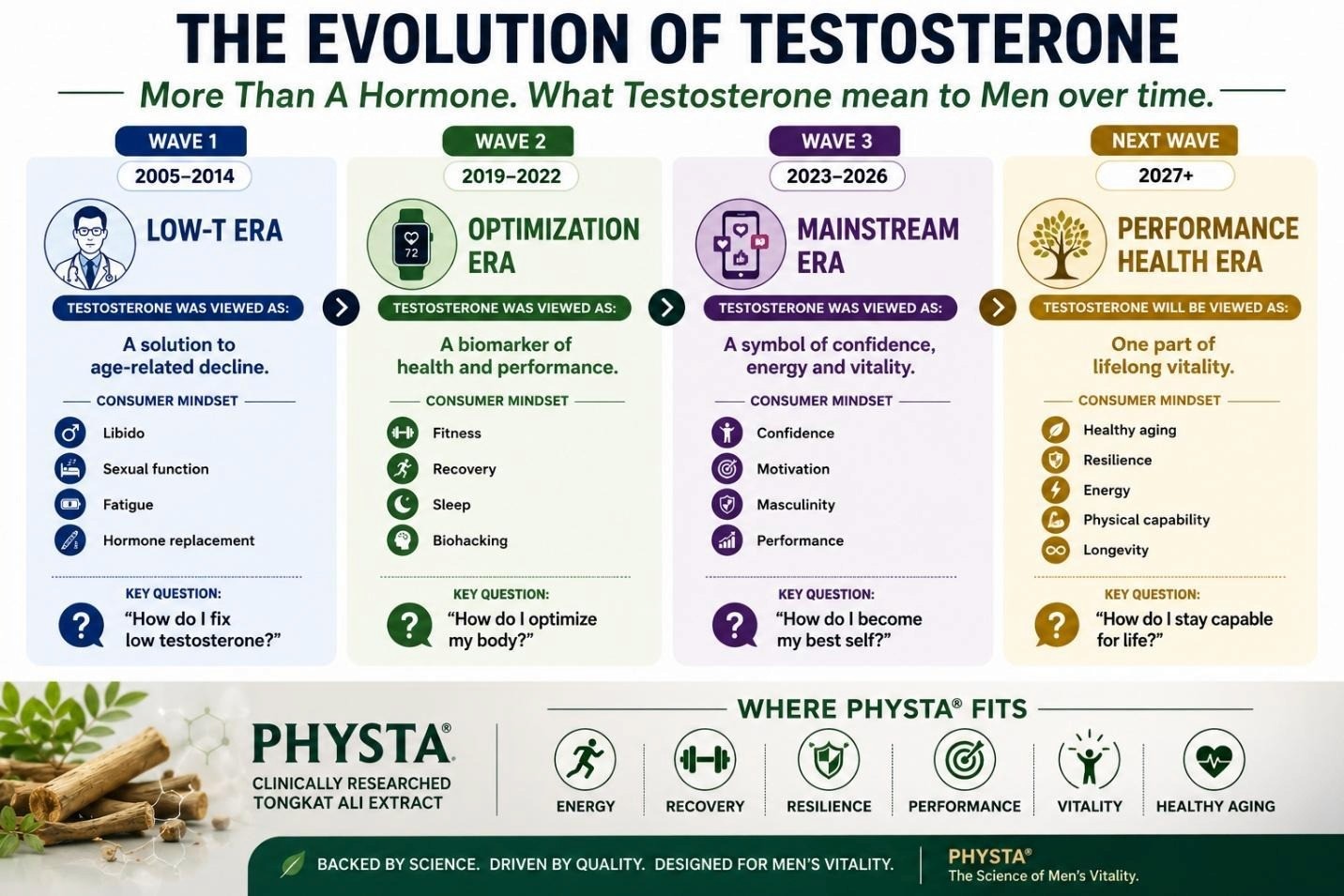
The deficiency era, roughly 2001 to the mid-2010s. Awareness of age-related testosterone decline rose sharply, testosterone replacement therapy became far more visible, and "Low T" entered everyday language. Prescribing data from this period documents the scale of the shift (Baillargeon et al., 2013; Handelsman, 2013). The conversation was medical, and it was about deficiency and treatment.
The optimization era, from the late 2010s. Wearables, sleep tracking, personalized nutrition and the longevity conversation moved the goal from fixing a problem to improving a baseline. Testosterone became 1 metric among many rather than a diagnosis.
The mainstream era, now. Podcasts, fitness communities and social media have made hormone health a general-interest topic. But underneath the volume, the demand has not really changed. People are not looking for testosterone. They are looking for what they think testosterone will give them.
What men are actually looking for
6 things come up repeatedly:
Energy that lasts through the working day
Recovering from training without losing days to it
Handling stress without it flattening everything else
Holding onto strength and muscle through their 40s and 50s
Sleeping properly
Feeling like themselves
None of those is a hormone reading. All of them are outcomes, and the gap between wanting them and getting them is wide. In McKinsey's 2026 wellness survey of more than 9,000 consumers, 84% said wellness was a top priority or important to them, while only 13% said they were actually achieving their wellness goals.
What the research on Tongkat Ali actually measured
[IMAGE 3.2 — Graphic, built by ourteam. What the trials measured (tension, anger, confusion, fatigue, cortisol, recovery) against testosterone alone. Optional.]
Tongkat Ali (Eurycoma longifolia) is a Southeast Asian root with a long history of traditional use as an energy tonic. The modern research on it runs to 28 human clinical studies, 18 of them randomized controlled trials, involving 1,290 participants, almost all conducted on 1 standardized extract.
What is worth noticing is what those trials chose to measure. They did not only look at hormones. Results in a trial are not a promise for any individual.
Fatigue and energy in older men. In 105 people aged 50 to 70 over 12 weeks, fatigue fell 50% and Ageing Male Scores fell 54%, alongside improvements in muscle tone. Total testosterone, free testosterone and DHEA all rose significantly against placebo. Changes appeared by week 2 at 200 mg a day (Chinnappan et al., 2021).
Stress and mood. In 63 moderately stressed adults taking 200 mg a day for 4 weeks, tension fell 11%, anger 12% and confusion 15%, alongside testosterone 37% higher and cortisol 16% lower than placebo (Talbott et al., 2013). A longer 24-week trial in 93 moderately stressed adults recorded a 15% reduction in stress compared with 0.7% in the placebo group, using 50 mg a day combined with a multivitamin (George et al., 2018).
Recovery under physical load. In 30 male athletes riding a 24-hour mountain biking event, a single 100 mg dose taken before the ride left testosterone 16% higher and cortisol 32% lower than placebo (Talbott and George, 2024). That combination, cortisol down and testosterone held up during sustained effort, is what recovery looks like at the hormonal level.
Strength and training results. In 45 men aged 40 to 55 over 6 months, exercise alone increased muscle strength 14%, while exercise with 200 mg a day increased it 17%. Aging male symptom scores fell 27% with exercise alone and 36% with exercise plus supplementation (Leitão et al., 2021, 45 enrolled, 37 randomized and analyzed). In a shorter 5-week study in 14 men on a strength program, lean body mass rose 4% and strength 6%, against no significant change and 2% in the placebo group (Hamzah and Yusuf, 2003).
And it does not act like a banned substance. In a double-blind placebo-controlled crossover study of 13 men taking 400 mg a day, the testosterone to epitestosterone ratio used in anti-doping testing did not change significantly against placebo (Chen et al., 2014). A second study in 40 healthy men at 300 mg a day found the same: the ratio stayed within normal limits (George et al., 2013).
Read together, the pattern is consistent: the effects that show up most reliably are on stress, fatigue, recovery and the hormonal balance between testosterone and cortisol, rather than on raising testosterone as an end in itself.
Where this fits, and where it does not
2 honest limits are worth stating.
First, a supplement is not a substitute for the basics. Sleep, training and managing stress load do more for how a man feels at 45 than any capsule, and the trials above were mostly run alongside exercise, not instead of it. The Leitão result is a good illustration: exercise alone produced most of the benefit, and supplementation added to it.
Second, if you have symptoms that concern you, get your testosterone measured and talk to a doctor. Persistent fatigue, low mood and loss of strength have many possible causes, and some of them need medical attention rather than a supplement.
As with anything you take, if you are on prescription medication or managing a health condition, speak to your doctor first.
What to check before you buy
Tongkat Ali products vary enormously, and the label usually does not tell you which one you have. We bought 22 Tongkat Ali extracts on the open market and tested them: 2 met the Malaysian Standard on all 4 measured compounds. A product sold as 200:1 contained 0.05% eurycomanone, while one sold as 10:1 contained 0.98%.
[Link: See the full results of the 22-extract analysis]
3 checks: a named standard rather than a ratio, water extraction from the root, and a quantity in milligrams so you can compare it with what the trials used, which was most often 200 mg a day, with 400 mg the next most studied. A named, standardized ingredient does the checking for you. Physta® is one, and in the United States the same extract appears on labels as LJ100®.
[Link: What Physta® is standardized to, and the research behind it]
Frequently asked questions
Does Tongkat Ali increase testosterone?
In the controlled trials above, yes, against placebo. In 63 moderately stressed adults, testosterone was 37% higher than placebo after 4 weeks at 200 mg a day. In 105 adults aged 50 to 70, total and free testosterone and DHEA rose significantly over 12 weeks. Results in a trial are not a promise for any individual.
Does it help with energy and fatigue?
That is what most of the research measured. In the 12-week trial in 105 adults aged 50 to 70, fatigue fell 50% and Ageing Male Scores fell 54%. Stress, mood and recovery measures improved across the other trials.
How long does it take to notice anything?
In the 12-week trial in adults aged 50 to 70, changes appeared by week 2 at 200 mg a day and week 4 at 100 mg. Most trials ran between 4 and 24 weeks.
What dose was used in the research?
Most commonly 200 mg a day, with 400 mg the next most studied Some trials recorded effects at 50 mg and 100 mg. Safety has been assessed up to 600 mg a day.
Is it a steroid?
No. It is a root extract. In 2 double-blind placebo-controlled studies, the ratio anti-doping tests measure did not change significantly against placebo.
Should I get my testosterone tested first?
If you have symptoms that concern you, yes, and discuss the results with a doctor. Fatigue and low mood have many causes.
Is this only for older men?
The trials span ages 18 to 70 and include women. The 50 to 70 age group shows the clearest testosterone results, while the stress and recovery results come from younger and mixed-age groups.
Related Articles

Men's Health
What Is PHYSTA® Tongkat Ali Extract?
What sets PHYSTA® apart from generic Tongkat Ali: a standardized, MIT co-developed extract studied in 28 human clinical studies.

Quality
Does a Higher Extract Ratio Mean a Stronger Tongkat Ali Supplement?
We tested 22 Tongkat Ali extracts. Why the ratio on the label tells you little about what is actually in the capsule.

Women's Health
Menopause: What Is Actually Happening, and What Helps
What actually changes in perimenopause and menopause, and which options, from lifestyle to supplements, have real evidence behind them.
